Charles Ives

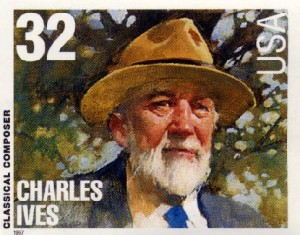
Charles Ives (1874-1954) was born in Danbury, CT, studied organ and composition in New York, but got employed as insurance agent, a job in which he was quite successful. Composing became an activity for his spare time. Because his income did not depend on his musical activities, he was able to do whatever he liked. That he did, indeed. In fact, he did that so fanatically that contemporary musicians and composers could not (or did not want to) really understand what he was doing.

Charles Ives

Charles Ives

Charles was surrounded with musical originality from his earliest youth. His father showed an unrestrained interest in all kinds of musical experiments. For example, what do you hear if you let two brass bands march towards each other while they are playing different music and you take position in the middle of them? Or, what happens if you accompany a song in another key than the singer is singing in? In both cases, existing material is used to make something that is both unexpected and new. Exactly this is a main theme in the work of Charles. Did you ever hear such a diversity within half a minute as in this fragment from the Country Band March: (mp3source
The Orchestral Music of Charles Ives
The Orchestral Music of Charles Ives. By: Orchestra New England, James Sinclair (Koch 3-7025-2)

Details: Amazon.com or Emusic.com
)
.

Ives was not only interested in subsequent juxtaposition of musical ideas, but also in simultaneous combinations of different kinds of music. An extraordinary example of this is Fourth of July. Imagine strolling around in an American town on the 4th of July. A diversity of sound would reach you from all directions: a brass band, people singing songs, a baseball game, fireworks, etc. Ives put all these 4th-of-July-sounds in 6 minutes of music: (mp3source
Americana
Americana. By: Dallas Symphony Orchestra; Donald Johanos (Vox CDX-5182)

Details: Amazon.com or Emusic.com
)
. It takes three conductors to perform the work.

Another main theme throughout Ives’ career is his interest in well-known American melodies. This involves church songs as well as folk songs. In about all of his compositions these melodies are incorporated in one way or another. In the fourth symphony, his largest work, dozens of melodies are used, from “Nearer, My God, to Thee” to “Home, sweet home”.

Ives was not really popular during his lifetime, but after his death this changed completely. Apparently, it was only then that other musicians and composers got interested in things that Ives did already years earlier. He had been far ahead of his time. It was only in 1965 that his fourth symphony was performed for the first time. He did not hear it himself. Nowadays, Ives is regarded one of the first major American composers.

Recommended cd’s

The Orchestral Music of Charles Ives
The Orchestral Music of Charles Ives. By: Orchestra New England, James Sinclair (Koch 3-7025-2)

Details: Amazon.com or Emusic.com

Americana
Americana. By: Dallas Symphony Orchestra; Donald Johanos (Vox CDX-5182)

Details: Amazon.com or Emusic.com

Symphonies 1-4/Holidays Symphony [...]
Symphonies 1-4/Holidays Symphony [...]. By: Chicago Symphony Orchestra en Royal Concertgebouw Orchestra; Michael Tilson Thomas (Sony SB 3K87746)


Antonio Vivaldi

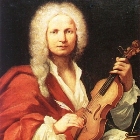
Anyone who is familiar with classical music knows the Italian Baroque composer Antonio Vivaldi (1678-1741). Particularly famous are his Four Seasons, of which almost as many recordings exist as there are violists. It might therefore be surprising that Vivaldi and his music were unknown for more than one hundred years. From several decades after his death until the beginning of the twentieth century, Vivaldi’s compositions were rarely heard.

Antonio Vivaldi

Antonio Vivaldi

During his lifetime, Vivaldi was famous; not only as composer, but also as a violist. Apart from being a musician, he was a cleryman as well. In 1703 he was ordained priest, but soon he resigned, maybe because of a chronic bronchitis, or because his musical ambitions were in the end stronger than his clergical ambitions.

He wrote many compositions for the choir and orchestra of the Pio Ospedale della Pietà, a Venetian Institution devoted to the care of ophnaned girls, where he was appointed maestro di violino in 1703 and later maestro dei concerti.

Vivaldi was well known for his vanity. He stated, for example, that he was able to compose a piece in shorter time than someone else could copy it. This may be exaggerated, but it is definitely true that he was a quite prolific composer. The catalog that was compiled in 1973 by Peter Ryom (the Ryom Verzeichnis – RV), mentions more than 700 compositions, including aproximately 550 concertos.

Already during his lifetime, his reputation was declining. He probably died in poverty. He ows his rediscovery to another Baroque composer, Johann Sebastian Bach (who was actually forgotten for half a century as well). Bach transcribed some of Vivaldi’s concertos for harpsichord and organ. For example, the concerto for two violins and orchestra op 3.8 (mp3source
Vivaldi: Double Concertos
Vivaldi: Double Concertos. By: Akademie für alte Musik (Harmonia Mundi France HMC 901975)

Details: Amazon.com or Emusic.com
)
, was transcribed by Bach for organ: (mp3source
Bach: Organ Works, Vol. 15
Bach: Organ Works, Vol. 15. By: Gerhard Weinberger (CPO 777018)

Details: Amazon.com or Emusic.com
)
.

Obviously, Bach was very interested in these concertos. When the Bach research came to steam in the nineteenth century, it was for this reason that researches got interested in Vivadi’s music. They looked up Vivaldi’s originals of the Bach transcriptions, and they concluded that Bach actually made it better. Only in the early twentieth century, Vivaldi was fully rehabilitated when musicologists discovered the important role he played in the history of the concerto – and with that, in the pre-history of the symphony. The rediscovery of his personal music archive in 1920 made his star rise even faster. Today he is among the big money makers for the classical music industry.

Recommended cd’s

Vivaldi: Double Concertos
Vivaldi: Double Concertos. By: Akademie für alte Musik (Harmonia Mundi France HMC 901975)

Details: Amazon.com or Emusic.com

Bach: Organ Works, Vol. 15
Bach: Organ Works, Vol. 15. By: Gerhard Weinberger (CPO 777018)

Details: Amazon.com or Emusic.com

Download 25 FREE songs at eMusic.com!

The further one goes back into music history, the more authorship questions arise. It is even possible that one and the same composition is attributed to different composers in different historical manuscripts. Often, though not always, the availability of an autograph (the manuscript of the composer himself) provides sufficient evidence to attribute the piece. Of many pieces, however, only copies have survived. Therefore, it can be quite a puzzle to find the composer of a certain composition.

A recent solution of an authorship question added an interesting composer to Dutch music history. The compositions in question are six Concerti Armonici, a collection of concertos for strings and basso continuo, which were composed in the first half of the eighteenth century. To get an impression of the pieces, listen to these two fragments from the fifth concerto: Adagio-Largo (mp3source
Wassenaer: 6 Concerti Armonici
Wassenaer: 6 Concerti Armonici. By: Amsterdam Baroque Orchestra; Ton Koopman (Apex 0927495712)

Details: Amazon.com
)
, and Da Capella (mp3source
Wassenaer: 6 Concerti Armonici
Wassenaer: 6 Concerti Armonici. By: Amsterdam Baroque Orchestra; Ton Koopman (Apex 0927495712)

Details: Amazon.com
)
. In 1740 these concerti appeared in print in The Hague. The edition was prepared by Carlo Ricciotti, who was a well known music publisher and violist. He dedicated the music to the Dutch nobleman Willem Bentinck. In his preface, Ricciotti tells us that this music was composed by an ‘illustrious hand’. He mentions no name, though. Since the compositions are of high quality, there has been quite some interest in the question to who this illustrious hand belonged.

In 1755, the score was printed again. This time in London by publisher Walsh. In those days, in which copyright was not regulated by law, such things could happen. Walsh attributed the pieces to Ricciotti. In later times further attributions were made to Georg Friedrich Handel, Johann Adam Birkenstock, Fortunato Chelleri and Giovanni Battista Pergolesi. The attribution to Pergolesi has been the best known. Probably because he already was famous for his Stabat Mater, which makes an attribution to him interesting from a commercial perspective. Who will buy a recording of concerti by a certain Birkenstock?

The solution to this question was found in 1980 by the Dutch musicologist Albert Dunning, nearly 250 years after the concerti appeared in print for the first time. Dunning discovered a manuscript of the six concerti in the archives of the castle at Twickel. Attached to this manuscript he found a note of the composer stating that he wrote the pieces between 1725 and 1740, and that he, although reluctantly, gave permission to publish them in print. By comparing handwritings, Dunning showed that the note was written by Count Unico Wilhelm van Wassenaer, who lived at the castle at that time.

Graaf Unico Wilhelm van Wassenaer

After this identification, the pieces of the puzzle fell into place. Willem Bentinck, to who the compositions were dedicated, organized house concerts at which Carlo Ricciotti played first violin. Van Wassenaer had an high social position and consorted with important politicians. Probably he wanted to keep his musical activities private. Anyhow, with this discovery music history has been enriched with an interesting composer.

Recommended cd’s

Wassenaer: 6 Concerti Armonici
Wassenaer: 6 Concerti Armonici. By: Amsterdam Baroque Orchestra; Ton Koopman (Apex 0927495712)

Details: Amazon.com


« Older entries