Baroque

You are currently browsing the archive for the Baroque category.

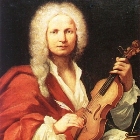
Antonio Vivaldi

Anyone who is familiar with classical music knows the Italian Baroque composer Antonio Vivaldi (1678-1741). Particularly famous are his Four Seasons, of which almost as many recordings exist as there are violists. It might therefore be surprising that Vivaldi and his music were unknown for more than one hundred years. From several decades after his death until the beginning of the twentieth century, Vivaldi’s compositions were rarely heard.

Antonio Vivaldi

Antonio Vivaldi

During his lifetime, Vivaldi was famous; not only as composer, but also as a violist. Apart from being a musician, he was a cleryman as well. In 1703 he was ordained priest, but soon he resigned, maybe because of a chronic bronchitis, or because his musical ambitions were in the end stronger than his clergical ambitions.

He wrote many compositions for the choir and orchestra of the Pio Ospedale della Pietà, a Venetian Institution devoted to the care of ophnaned girls, where he was appointed maestro di violino in 1703 and later maestro dei concerti.

Vivaldi was well known for his vanity. He stated, for example, that he was able to compose a piece in shorter time than someone else could copy it. This may be exaggerated, but it is definitely true that he was a quite prolific composer. The catalog that was compiled in 1973 by Peter Ryom (the Ryom Verzeichnis – RV), mentions more than 700 compositions, including aproximately 550 concertos.

Already during his lifetime, his reputation was declining. He probably died in poverty. He ows his rediscovery to another Baroque composer, Johann Sebastian Bach (who was actually forgotten for half a century as well). Bach transcribed some of Vivaldi’s concertos for harpsichord and organ. For example, the concerto for two violins and orchestra op 3.8 (mp3source
Vivaldi: Double Concertos
Vivaldi: Double Concertos. By: Akademie für alte Musik (Harmonia Mundi France HMC 901975)

Details: Amazon.com or Emusic.com
)
, was transcribed by Bach for organ: (mp3source
Bach: Organ Works, Vol. 15
Bach: Organ Works, Vol. 15. By: Gerhard Weinberger (CPO 777018)

Details: Amazon.com or Emusic.com

)
.

Obviously, Bach was very interested in these concertos. When the Bach research came to steam in the nineteenth century, it was for this reason that researches got interested in Vivadi’s music. They looked up Vivaldi’s originals of the Bach transcriptions, and they concluded that Bach actually made it better. Only in the early twentieth century, Vivaldi was fully rehabilitated when musicologists discovered the important role he played in the history of the concerto – and with that, in the pre-history of the symphony. The rediscovery of his personal music archive in 1920 made his star rise even faster. Today he is among the big money makers for the classical music industry.

Recommended cd’s

Vivaldi: Double Concertos
Vivaldi: Double Concertos. By: Akademie für alte Musik (Harmonia Mundi France HMC 901975)

Details: Amazon.com or Emusic.com
Bach: Organ Works, Vol. 15
Bach: Organ Works, Vol. 15. By: Gerhard Weinberger (CPO 777018)

Details: Amazon.com or Emusic.com

The further one goes back into music history, the more authorship questions arise. It is even possible that one and the same composition is attributed to different composers in different historical manuscripts. Often, though not always, the availability of an autograph (the manuscript of the composer himself) provides sufficient evidence to attribute the piece. Of many pieces, however, only copies have survived. Therefore, it can be quite a puzzle to find the composer of a certain composition.

A recent solution of an authorship question added an interesting composer to Dutch music history. The compositions in question are six Concerti Armonici, a collection of concertos for strings and basso continuo, which were composed in the first half of the eighteenth century. To get an impression of the pieces, listen to these two fragments from the fifth concerto: Adagio-Largo (mp3source
Wassenaer: 6 Concerti Armonici
Wassenaer: 6 Concerti Armonici. By: Amsterdam Baroque Orchestra; Ton Koopman (Apex 0927495712)

Details: Amazon.com
)
, and Da Capella (mp3source
Wassenaer: 6 Concerti Armonici
Wassenaer: 6 Concerti Armonici. By: Amsterdam Baroque Orchestra; Ton Koopman (Apex 0927495712)

Details: Amazon.com
)
. In 1740 these concerti appeared in print in The Hague. The edition was prepared by Carlo Ricciotti, who was a well known music publisher and violist. He dedicated the music to the Dutch nobleman Willem Bentinck. In his preface, Ricciotti tells us that this music was composed by an ‘illustrious hand’. He mentions no name, though. Since the compositions are of high quality, there has been quite some interest in the question to who this illustrious hand belonged.

In 1755, the score was printed again. This time in London by publisher Walsh. In those days, in which copyright was not regulated by law, such things could happen. Walsh attributed the pieces to Ricciotti. In later times further attributions were made to Georg Friedrich Handel, Johann Adam Birkenstock, Fortunato Chelleri and Giovanni Battista Pergolesi. The attribution to Pergolesi has been the best known. Probably because he already was famous for his Stabat Mater, which makes an attribution to him interesting from a commercial perspective. Who will buy a recording of concerti by a certain Birkenstock?

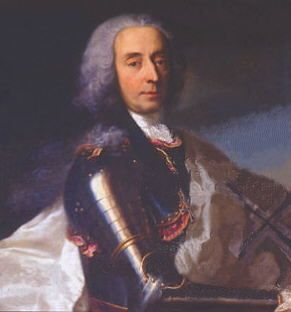
The solution to this question was found in 1980 by the Dutch musicologist Albert Dunning, nearly 250 years after the concerti appeared in print for the first time. Dunning discovered a manuscript of the six concerti in the archives of the castle at Twickel. Attached to this manuscript he found a note of the composer stating that he wrote the pieces between 1725 and 1740, and that he, although reluctantly, gave permission to publish them in print. By comparing handwritings, Dunning showed that the note was written by Count Unico Wilhelm van Wassenaer, who lived at the castle at that time.

Graaf Unico Wilhelm van Wassenaer

After this identification, the pieces of the puzzle fell into place. Willem Bentinck, to who the compositions were dedicated, organized house concerts at which Carlo Ricciotti played first violin. Van Wassenaer had an high social position and consorted with important politicians. Probably he wanted to keep his musical activities private. Anyhow, with this discovery music history has been enriched with an interesting composer.

Recommended cd’s

Wassenaer: 6 Concerti Armonici
Wassenaer: 6 Concerti Armonici. By: Amsterdam Baroque Orchestra; Ton Koopman (Apex 0927495712)

Details: Amazon.com


Download 25 FREE songs at eMusic.com!

The sequence Dies Irae (mp3source
Gregorian Chant - Sequences
Gregorian Chant – Sequences. By: Capella Antiqua München; Konrad Ruhland (Sony SBK 61868)
)
is part of the Requiem Mass, which is celebrated for the departed. In threatening words, the Dies Irae announces the final judgment: “Day of wrath! O day of mourning! See fulfilled the prophets’ warning, Heaven and earth in ashes burning!”. On that day, when history will end, creation will have to give an account of itself to God. Who could exist in such a judgment? It, therefore, is no surprise that the last part of the text is a prayer for the soul’s eternal rest.

This text has been set to music very often; in most cases as part of a Requiem. The earliest Requiem that includes the Dies Irae, is the one by Antoine Brumel (c.1460-1512/3) (mp3source
Antoine Brumel - Missa 'Et ecce terrae motus', Sequentia 'Dies Irae'
Antoine Brumel – Missa ‘Et ecce terrae motus’, Sequentia ‘Dies Irae’. By: Huelgas Ensemble; Paul van Nevel (Sony SK 46348)

Details: Amazon.com
)
. In the course of music history, the binding with the original gregorian melody declines. The Italian composer Antonio Lotti (1660-1740) provided completely new music for the Dies Irae: (mp3source
Antonio Lotti - Requiem
Antonio Lotti – Requiem. By: Balthasar-Neumann-Chor und -Ensemble; Thomas Hengelbrock (Deutsche Harmonia Mundi 05472 77507 2)

Details: Amazon.com
)
. A few decades later, Mozart composed his a Dies Irae as part of his Requiem, which is a personal document rather than liturgical music. He used more expressive means than his predecessors to display the overwhelming character of the Dies Irae (mp3source
W.A. Mozart - Requiem
W.A. Mozart – Requiem. By: Philippe Herreweghe (Harmonia Mundi France HMX 2901620)

Details: Amazon.com or Emusic.com
)
. This development was carried on further in the nineteenth century, in which the approach became more and more megalomaniac. An impressive climax is the Dies Irae (1874) by Giuseppe Verdi (1813-1901) in which the final judgement is announced with thundering violence (here in a performance conducted by Claudio Abbado):

Thus, the text of the Dies Irae was widely used without its original melody. The opposite also happened often: the gregorian melody has been included in many instrumental works, especially the opening motif: (mp3source
Gregorian Chant - Sequences
Gregorian Chant – Sequences. By: Capella Antiqua München; Konrad Ruhland (Sony SBK 61868)
)
. Within the nineteenth-century Romantic movement, in which artists were fascinated by such notions as transiency, lunacy, morbidity, ruins, night and death, this melody became a symbol for threath, darkness and decease. One of the earliest examples can be found in the fifth movement of the Symphonie Fantastique (1830) by Hector Berlioz, which depicts a witches’ sabath (mp3source
Berlioz - Symphonie Fantastique
Berlioz – Symphonie Fantastique. By: New York Philharmonic; Zubin Mehta (Decca 448 987-2)
)
. Another famous example is the Dance Macabre by Camille Saint-Saëns, a symphonic poem that has a poem by Henri Cazalis about death as its program (mp3source
Saint-Saëns - Dance Macabre
Saint-Saëns – Dance Macabre. By: Philharmonia Orchestra, Charles Dutoit – Royal Philharmonic Orchestra, Kyung Wha Chung (Decca 425 021-2)

Details: Amazon.com
)
. Also the composer Sergej Rachmaninoff was obsessed by the theme. In numerous of his instrumental works the characteristic motif is cited. For instance in the symphonic poem The Isle of the Dead (1909), which is related to the painting Die Toteninsel by Arnold Böcklin. After a climax, a passage follows in which one by one various instruments play the Dies Irae theme (mp3source
Rachmaninov - Symphony No.1 - Isle of the Dead
Rachmaninov – Symphony No.1 – Isle of the Dead. By: The Philharmonia; Jacek Kaspszyk (Collins 12132)
)
.

Böcklin - Toteninsel (third version, 1883)
Böcklin – Toteninsel (third version, 1883)

Recommended cd’s

Antoine Brumel - Missa 'Et ecce terrae motus', Sequentia 'Dies Irae'
Antoine Brumel – Missa ‘Et ecce terrae motus’, Sequentia ‘Dies Irae’. By: Huelgas Ensemble; Paul van Nevel (Sony SK 46348)

Details: Amazon.com

Antonio Lotti - Requiem
Antonio Lotti – Requiem. By: Balthasar-Neumann-Chor und -Ensemble; Thomas Hengelbrock (Deutsche Harmonia Mundi 05472 77507 2)

Details: Amazon.com

W.A. Mozart - Requiem
W.A. Mozart – Requiem. By: Philippe Herreweghe (Harmonia Mundi France HMX 2901620)

Details: Amazon.com or Emusic.com

Saint-Saëns - Dance Macabre
Saint-Saëns – Dance Macabre. By: Philharmonia Orchestra, Charles Dutoit – Royal Philharmonic Orchestra, Kyung Wha Chung (Decca 425 021-2)

Details: Amazon.com

Verdi - Messa da Requiem
Verdi – Messa da Requiem. By: Claudio Abbado (EMI CDC 5 57168 2)

Details: Amazon.com

DVD Verdi Requiem
DVD Verdi Requiem. By: Claudio Abbado (EMI 926949)

Details: Amazon.com


« Older entries